



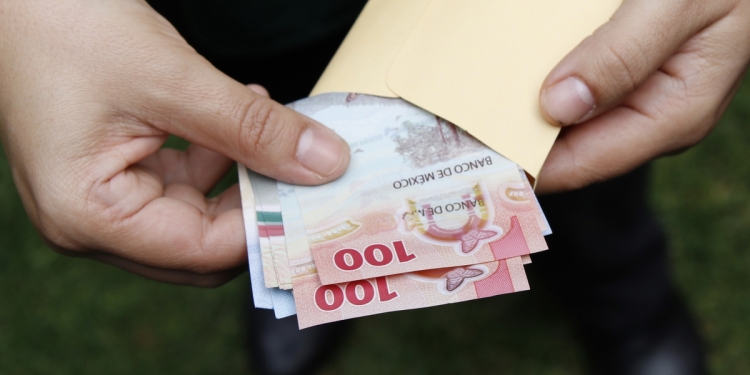
On Wednesday December 3, 2025 Mexico’s government announced that the country’s official general Daily Minimum Wage (Salario Minimo) would rise by 13% as of January 1, 2026. The minimum wage in the ‘Northern Border Zone’ will rise by 5%.
Mexico’s Daily Minimum Wage for 2026
As of January 1, 2026, Mexico’s daily minimum wage rises from to $278.80 to $315.04 pesos per work day.
The rate along the ‘Northern Border Zone’ will be increased in 2026 from $419.88 to $440.87 pesos per work day.
This latest increase marks the ninth consecutive year that Mexico has implemented double-digit percentage increases in the minimum wage. The rise in 2025-2026 is 1% higher than the rise in 2024-2025 for the general minimum wage, although in the ‘Northern Border Zone’ the 2026 rise of 5% lower than the 12% it was in 2025.
Mexico began inflation-busting annual increases of the Daily Minimum Wage in 2018 and, since then, the rate has risen 256.6%—from $88.36 to $315.04 Mexican pesos per work day.
Recent history of Mexico’s official daily Minimum Wage rises
As the table below illustrates, Mexico’s official Daily Minimum Wage (DMW) has risen significantly in recent years—far outpacing the rate of official inflation over the same period.
| Year | DMW (MXN Pesos) | YoY % Rise |
| 2016 | $73.04 | 4% |
| 2017 | $80.04 | 9% |
| 2018 | $88.36 | 10% |
| 2019 | $102.68 | 16% |
| 2020 | $123.22 | 20% |
| 2021 | $141.70 | 15% |
| 2022 | $172.87 | 23% |
| 2023 | $207.44 | 20% |
| 2024 | $248.93 | 20% |
| 2025 | $278.80 | 12% |
| 2026 | $315.04 | 13% |
Northern Border Zone
In 2019, Mexico introduced a ‘Northern Border Zone’ (NBZ) that started with a Daily Minimum Wage (DMW) of $177.72 pesos a day. The ‘Northern Border Zone’ is a defined set of municipalities in Mexican states bordering the USA.
The table below illustrates the changes in Daily Minimum Wage since 2019 for workers situated in the NBZ.
| Year | DMW (MXN Pesos) NBZ | YoY % Rise |
| 2019 | $177.72 | N/A |
| 2020 | $183.56 | 20% |
| 2021 | $213.39 | 15% |
| 2022 | $260.34 | 23% |
| 2023 | $312.41 | 20% |
| 2024 | $374.89 | 20% |
| 2025 | $419.88 | 12% |
| 2026 | $440.87 | 5% |
YoY=Year-on-Year.
The effect of minimum wage rises on Mexico residency applications
In July 2025, Mexico’s government announced revised guidelines for residency qualification that included an alignment of the qualification criteria with UMA, instead of the Daily Minimum Wage.
Mexican consulates abroad may increase amounts required in line with the UMA increase (that tends to increase each year with the official rate of inflation) or they may use other criteria to calculate the increase in 2026. We will update our guide to the financial criteria required to obtain legal residency in Mexico as reliable information becomes available.
Calculating the cost of living in Mexico
Our guide to the Cost of Living in Mexico is a comprehensive source of information about prices in Mexico that can help you to form a detailed budget based on your individual plans and circumstances.
Minimum Wage vs UMA: The uncoupling of minimum wage to official prices
In the years before 2018, Mexico’s minimum wage had been raised more-or-less in line with official annual inflation, to avoid a wave of wage demands that could cause a spiral of increases in prices and wages which would eventually have the most impact on the poorest people. The problem was that the minimum wage had for years been so low that it wasn’t enough to for a single person to live on, never mind a whole family.
The decision to start raising the daily minimum wage more than other wages in a bid to even-up earnings took several years to implement. First it was necessary to uncouple thousands of official prices —including things like speeding fines and home loans— which for years were determined in multiples of the minimum wage.
For example, a big increase in the minimum wage level would have made hundreds of thousands of mortgages from the government-run agency Infonavit unaffordable.
The process of creating a new unit of value to replace the minimum wage for those prices took more than a year. There was also a need to take into consideration studies on the possible effects that the change would have on wages and employment.
In 2016, Mexico introduced the Unidad de Medida y Actualización (UMA) to enable minimum salaries to rise without adversely affecting other official costs and charges.