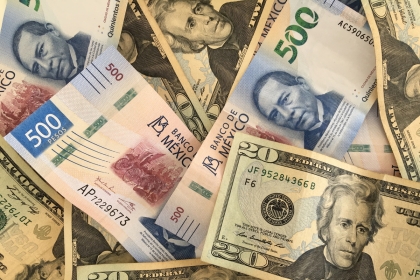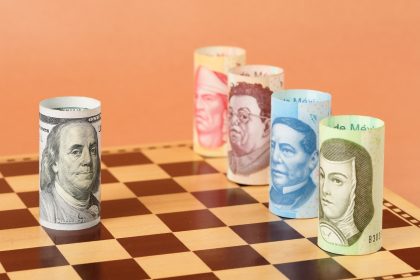






Mexico’s peso made quite a recovery in 2025 after a roller coaster 2024, gradually strengthening throughout the year against the US dollar but without the kind of volatility seen the year before.
The peso went from 20.88 at the end of 2024 to 18 to the dollar by the end of 2025, a noticeable 16% appreciation.
Factors supporting Mexico’s peso
One of the reasons for the peso’s appreciation was the US dollar’s nearly 10% depreciation against a basket of currencies, although the peso also gained about 2% against the euro and 10% against the Canadian dollar.
One of the main concerns at the start of 2025 was that the import tariffs imposed by President Trump would make a huge dent in Mexico’s exports, more than 80% of which go to the US. As it turned out, exports made under the rules of the US-Mexico-Canada trade agreement, known as USMCA, were exempt.
Although tariffs were imposed on automobiles, steel, and aluminum, the US content in vehicles assembled in Mexico was subtracted, and auto parts were excluded. What that means is that Mexico currently has an advantage over other countries that compete for a share of that US import market.
Inflation ended the year at 3.7%, down from 4.2% in 2024, according to government figures.
Cross-border influences
The sharp rise in silver prices toward the end of 2025 could also have helped the peso, as Mexico is currently the world’s biggest producer of the metal even though the country has only 6% of the world’s total known silver reserves. (Peru, Australia and Russia have the largest known silver reserves.)
The peso continued to benefit from the so-called carry trade, where investors borrow money in currencies that have low interest rates and use that money to invest it in places with higher rates. The Bank of Mexico lowered its benchmark interest rate throughout the year, bringing it down to 7% from 10% at the start of 2025, although the rate remained higher than in many other countries.
Also on the positive side, the Mexican government continued its plans to reduce the budget deficit that the previous administration had increased in its final year when elections were held.
Pressure points on Mexico’s peso
On the negative side for the peso, Mexico’s economic growth slowed down considerably, including a contraction in the third quarter. The economy is widely expected to have grown just 0.4% last year, the worst performance since the 2020 recession.
Despite the slower growth and worries about trade, foreign direct investment increased in the first nine months of the year, reaching $40.9 billion compared with $36.7 billion in the same period of 2024.
Remittances from abroad, mostly from the US, fell 5% in the first 11 months to $56.5 billion, and looked set to post their first full-year drop since 2013.
Mexico’s tourism income increased
Foreign tourism income grew. The number of tourists excluding border areas rose marginally 0.6% to 21.8 million people in the January-October period, with spending up 4.3% at $23.7 billion, although 2% fewer visitors flew into the country. Total visitors including land border crossers rose 13.6% to more than 79 million in the 10-month period.
What to expect for the Mexican peso in 2026?
Mexico’s peso is a free-floating currency on the world’s foreign exchange markets. It’s one of the world’s most-traded currencies and is the most-traded of Latin America’s currencies.
As usual, expectations for the peso over the coming year vary widely. In the central bank’s December 2025 survey, the median estimate among analysts for the exchange rate at the end of 2026 is 19.23 pesos to the US dollar. Estimates range from 17.10 to 20.30 pesos to the dollar.
Exchange-rate predictions are subject to many variables and uncertainties, with consensus estimates shifting as events unfold and the exchange rate fluctuates in response to those events throughout the year. As mentioned in a related article, predicting exchange rates tends be a mug’s game.
Events that might influence the peso in 2026 include the sunset review of the USMCA scheduled for July 2026, and the possibility that it could lead to changes unfavorable to Mexico in the trade pact.
The economy is widely expected to pick up a little from 2025, which could be positive for the currency, and the Bank of Mexico is almost through lowering interest rates. Economists surveyed in December 2025 consider that the central bank will cut the benchmark interest rate by an additional half of a percentage point this year—from 7% to 6.5%.
Aside from the US dollar, the Bank of Mexico publishes indicative daily rates for the peso against a number of other currencies, including the Canadian dollar, the euro, and the yen.
Other movements that influence the peso’s value
Key market movements that determine the peso’s exchange rate in the market include:
- investors who buy pesos to purchase Mexican stocks, bonds or to make other capital or financial investments;
- investors who sell pesos to buy dollars or other currencies and transfer money into foreign investments, or to cover other financial obligations abroad;
- companies that use their earned pesos to buy dollars or other currencies to pay for imports, or to cover foreign obligations;
- companies that sell their foreign currency to buy pesos to pay for exports, or make capital investments and/or cover other financial obligations in Mexico;
- banks and financial institutions that receive foreign currency remittances from abroad and pay those funds out in pesos—this will include Mexicans living abroad sending money home, and foreign pension income and savings transferred here by e.g., retirees living in Mexico;
- and of course, foreign income derived from international travelers which tends to favor Mexico with a surplus given its popular tourism cities and resorts.
Learn more about money and currency in Mexico
Read our latest articles and guides related to money and finances.